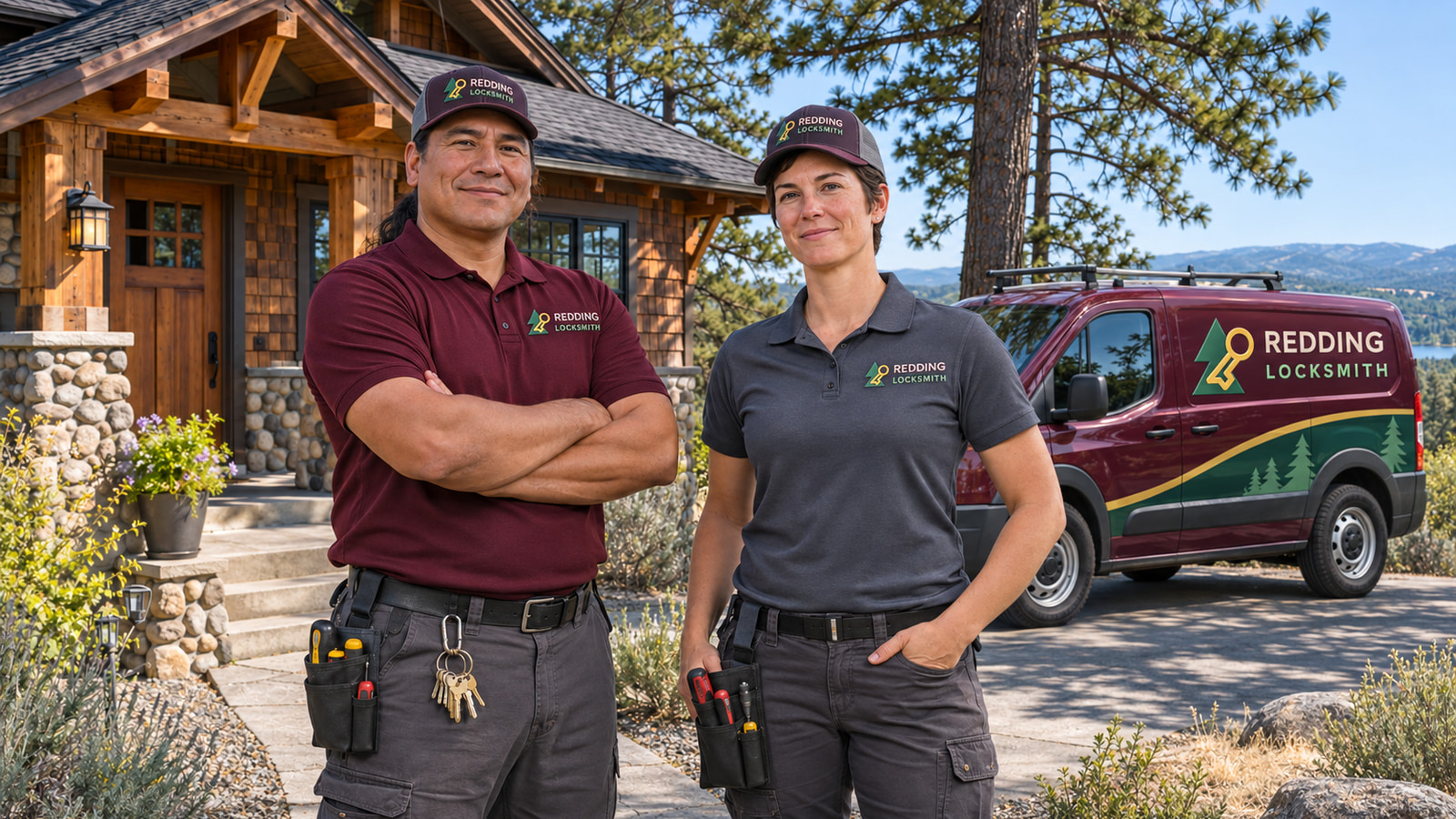
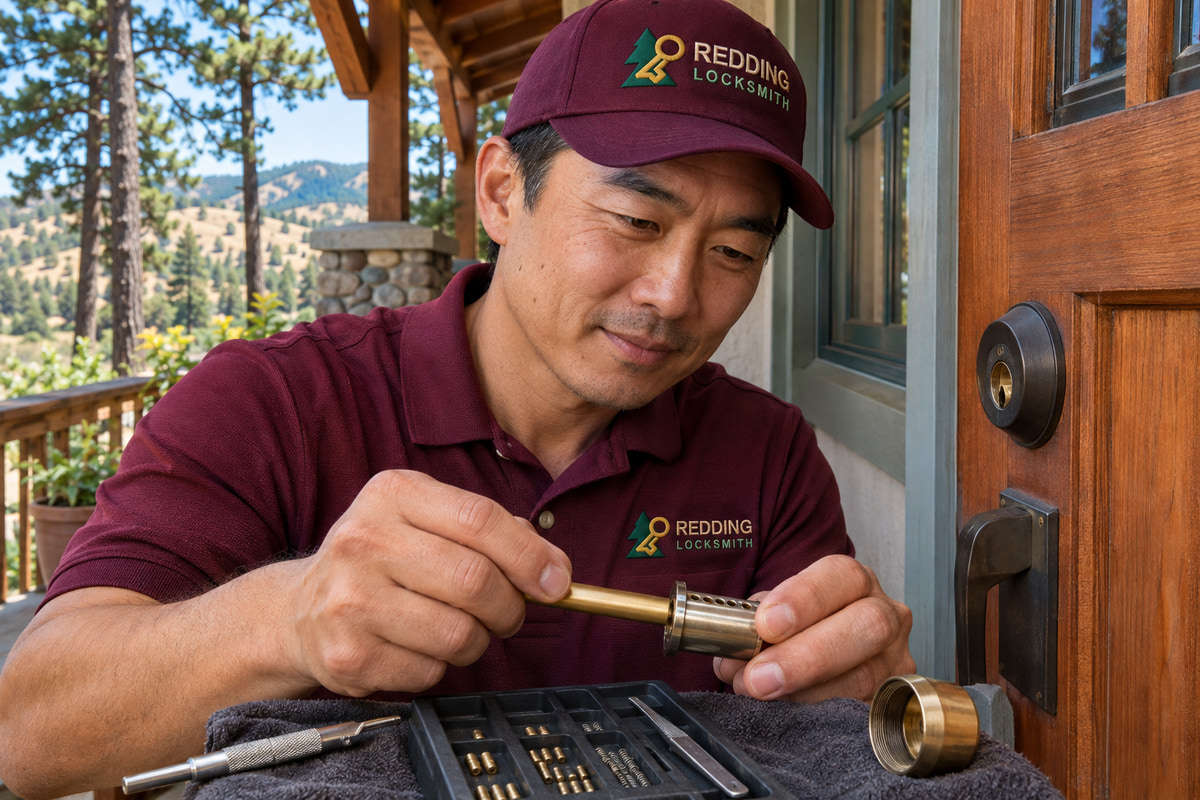
A family area with housing from several building periods
Southeast of the Sacramento River, the Enterprise area is made up largely of residential streets where families live, children walk or ride to school, and neighbors know which cars belong on which driveway. The Enterprise High School area gives the neighborhood a daily rhythm, with busy mornings, afternoon traffic and event nights. Housing here comes from more than one era. Some homes were built when ranch style houses were the standard, others came later, and newer streets have houses with the larger footprints and attached garages typical of recent subdivisions.
This mix has a direct effect on locks. A house from an earlier period may have original or early replacement hardware, doors that have been repainted many times, and frames that have settled. A newer house usually has deadbolts and lever handles installed by the builder, often in a matching finish chosen for appearance rather than for strength. Both kinds of house benefit from a look at what is actually protecting the door, and the answer is often different from what the owner assumed.
Families have patterns that shape lock problems. Children lose keys, forget them, or lock themselves out after school. Teenagers borrow vehicles and misplace fobs. Grandparents come to stay and are given a key that never gets returned. These are ordinary things, not signs of carelessness, but they add up to a household with more keys in circulation than anyone can account for. A single afternoon spent counting and sorting keys is a worthwhile exercise.
A third feature of the area is how spread out it can feel. Longer blocks, cul de sacs and streets that curve away from the main road make addresses harder to find for a stranger. When you call for help, say the street name, the nearest main road and a landmark if there is one, so that whoever is coming can find you without circling.
The aim of this page is not to scare anyone but to help families in these streets think calmly about the doors they use every day. Good locks do not need to be dramatic. They need to be in working order, fitted properly and matched with a plan for who holds the keys.
Consider a short example. A family buys a house on a curving street in this part of the city. The listing photos show a handsome front door and a matching set of hardware. After moving in, they notice that the back door lock takes a different key from the front, that a side gate padlock has no key at all, and that the garage entry door has a knob lock which turns without any key. None of this is unusual. A single visit to look at every lock, rekey the ones worth keeping and replace the ones that are too worn gives the family a tidy, understandable set of keys and a clear idea of what protects the house.
Front doors and the second look at what protects them
Most homeowners judge a front door by how it looks. A locksmith judges it by how it closes, how the latch meets the strike, and what lies behind the trim. In older family homes, the strike plate is often held by short screws that reach only into the thin door jamb. A firm push can split the jamb and defeat the lock without the lock itself being the weak point. Replacing those short screws with long ones that reach the framing behind the jamb is one of the most effective, least costly improvements a household can make.
Look also at the deadbolt itself. A good deadbolt has a bolt that extends a full inch into the frame and moves smoothly. Some deadbolts on older houses have a shorter throw or a worn mechanism that gives the impression of locking while holding poorly. If your bolt feels loose, lifts up and down when the door is locked, or does not fully extend, it deserves attention. Lubricating or rekeying may be enough, or replacement may be wiser.
Doors with glass beside or inside them, common in family houses with sidelights, raise a different point. A deadbolt that is keyed on both sides can be opened from inside only with a key, which can be a hazard in an emergency, and a deadbolt with a thumb turn inside is easier to use but more exposed if a pane can be broken. The best arrangement depends on the layout. A locksmith can talk through the trade offs and suggest what suits your door and your household.
Hinge side matters too. Hinges that are loose or short screwed let the door sag, and a sagging door puts stress on the latch. If you see uneven gaps around the door, or hear it scrape on the floor or the threshold, fix the hinges first. A tight, true door is a more secure door than a heavy one, and often needs nothing more than longer screws and an adjustment.
Finally, think about the door itself. Hollow doors are light and easy to damage, while solid ones are heavier and more resistant. Replacing a front door is a larger job that calls for a visit, but reinforcing the area around the lock with a strike box and a metal plate is a reasonable middle path that can be described over the phone.
Weather plays a role here too. Hot, dry summers shrink wood slightly and swell metal parts, while cooler wet months do the opposite. A door that fits perfectly in one season may rub in another. If you notice that a lock works well in the morning and sticks in the afternoon heat, or the other way round, tell the locksmith. That pattern points to fit and expansion, not a failing lock, and the cure is usually adjustment rather than replacement.
Garages, side gates and the back yard routes
Family homes in the Enterprise area typically include a garage, a side yard and a back yard, each with its own route into the house. In practice, the garage is the door most people use. Cars pull in, the garage door closes, and the family walks through a door into the kitchen or laundry room. That interior door often has a simple knob lock, or none, because it is assumed that the garage is secure. When the garage door is left open or its opener is lost, the house is more exposed than it appears.
The opener itself is a key of sorts. A remote clipped to a visor can be taken from a parked car. If that happens, the code should be changed, which most openers allow, and a spare remote should not be left in a vehicle overnight. A keypad on the outside is convenient, but use a code that is not obvious, and change it when contractors, cleaners or guests no longer need it.
Side gates and back yard gates bring their own lock needs. A simple latch is enough to keep a dog in, but not to keep someone out. Gate locks exposed to sun and weather fade and stiffen, and padlocks on gates can seize after a hot summer. A rinse, a dry cloth and a small amount of the right lubricant at the start of each season keeps most of them working. If a padlock will not open, avoid hammering it; a locksmith can usually open it without destroying the gate hardware.
Sliding glass doors to the patio are common in this kind of house. Many have a basic latch and no secondary lock. A bar in the track, a pin through the frame or a purpose made secondary lock adds real security for little effort. Check that the door's wheels are in good condition, because a door that has dropped on worn rollers can be lifted off its track and is much easier to defeat.
Outbuildings such as sheds, workshops and storage units should not share a key with the house. If they do, a lost shed key becomes a house key problem. Giving each its own key, and recording which is which, keeps a single mistake from becoming a larger one.
One more practical point about garages concerns the emergency release. Most automatic garage doors have a cord that disengages the opener so the door can be raised by hand. Thieves have been known to hook that release from outside through a gap at the top of the door. A simple fix is to make sure the gap is sealed with weatherstripping and, where the design allows, to use a release that cannot be reached from outside. Mention it if you want a locksmith to look at the garage as a whole, not only its entry door.
School days, busy schedules and the key habits of families
A neighborhood with a high school nearby has its own timetable. On weekday mornings, parents leave early, students leave on foot, bike or in a car, and keys are collected in a rush. On afternoons and event nights, traffic builds around the school and side streets fill with parked vehicles. These patterns affect lock calls in recognizable ways. Lockouts spike in the morning rush and the afternoon return, and lost key stories pile up around school events.
A practical approach for families is to decide in advance what happens when someone is locked out. Where can the child go? Which neighbor can be called? Is there a safe spare that is not hidden under a mat? A written plan on the refrigerator, with a few phone numbers, helps a young person feel calm in a situation that can otherwise feel frightening. Teach older children to call you first, rather than trying to climb through a window.
Keys themselves are worth discussing with teenagers. A key on a lanyard or clipped to a bag is harder to lose than one thrown into a pocket. A small tag with no address on it, only a phone number, may help a finder return a lost key without revealing where it belongs. Never put your home address on a keyring, because a lost key plus an address is an unwelcome combination.
Vehicle keys with electronic parts deserve special care, as replacing them is more involved than copying a simple metal key. If a family has two vehicles and one spare fob for each, label them and keep the spares at home, not in a glove box. When a fob is lost, report it promptly so that the vehicle can be reprogrammed if needed, which makes the lost fob useless to anyone who finds it.
Finally, remember that busy households benefit from smart or keypad locks only when they are reliable. A keypad deadbolt with a code for each family member removes the need to carry a key. Pair it with a physical key hidden with a trusted neighbor, since batteries die. These locks can be an excellent fit for a family, so long as someone remembers to change the batteries twice a year.
Event nights deserve a word. Football games, concerts and school gatherings fill parking areas and nearby streets, and cars parked at odd angles in unfamiliar places are easy to forget about in the dark. Keys fall out of pockets in crowds, and fobs slip out of bags. Before you leave the house, take a moment to note where your keys are and keep them in a zipped pocket if possible. After the event, check before closing the car door that the keys are in your hand and not on the seat.
Grandparents and other relatives who help with school runs also benefit from a clear arrangement. If they use a key to your house, give them one that you can later account for, and write down who has it. If an older relative has trouble with a stiff lock, consider swapping a round knob for a lever handle, which is much easier to use for people with weak grip or arthritis.
Moving in, rekeying and keeping control of the keys
Families move, and the first thing to do in a new house is to find out who has keys. Previous owners, real estate visitors, contractors and the person who mowed the lawn may all have had access. You cannot know how many copies exist. Rekeying the exterior locks resets the situation: the old keys stop working, and you hold the only ones. It can be done on existing locks, usually in a single visit, and is typically the most sensible first improvement after a move.
Choose a plan for how many keys you need and to whom they go. Many families find a design where all exterior doors use one key is convenient, because only one key must be carried. Others prefer separate keys for the garage, the shed and the house. Neither is wrong. What matters is knowing the system and being able to explain it to everyone who uses it, including a house sitter or an older relative.
When a house has been through many hands, take a careful look at the locks themselves. Mixed brands, mismatched finishes and a knob that does not match a deadbolt can be signs of repeated patching. This is not necessarily a problem, but it is an opportunity to bring the set into a consistent, well working arrangement, for instance with matching cylinders that all use one key.
Hardware upgrades should be proportionate. A new deadbolt with a reinforced strike may be more useful than a costly smart lock for a household with simple needs. A locksmith who listens to what you want and describes the trade offs, without hurrying to the largest option, is a good sign. Quotes follow a phone conversation, and a visit comes first for anything complicated, such as a door replacement or a multi door project.
Finally, keep a record. A simple note listing each lock, its location and who holds a key is more valuable than most people realize. When a key is lost or a family member moves out, you will know quickly what needs to change.
Smart and keypad locks deserve a brief honest note for newer homes in this area. They are convenient, but they bring different failure modes: dead batteries, forgotten codes, and software that needs attention. Before installing one, decide where the backup key will be, how guests will be given access, and how you will change codes when someone no longer needs one. A lock is only as secure as the habits around it.
If you are rekeying many locks at once, ask whether the cylinders can be keyed to match your car or garage keys where the types allow. Fewer keys means fewer opportunities to lose one. It also makes it simpler to give a neighbor a single key to hold in case of emergency.
Getting ready for a service visit at a family home
When a locksmith comes to a family house, a little preparation goes a long way. Clear a path to the door being worked on, and put pets in a safe room. Have your identification and something that shows the house is yours or rented by you. If you rent, have the landlord's name and number to hand in case permission is needed for changes.
Tell the locksmith about any quirks. Does the door stick in wet weather? Does a particular key need a jiggle? Has someone tried to force it? Is there an alarm system that will react when the door is opened? These details are easy to forget in the moment and save time when mentioned early.
Think about what else you want done while the locksmith is there. If the visit is for a lockout, you may also want a spare made, a worn strike plate replaced or a rekey of the exterior doors. Adding to the work on the day is often simpler than scheduling a second visit, but discuss it first so you understand what is involved before anything starts.
Afterward, test every key on every lock before the locksmith leaves. Turn each one a few times, check that the doors close and latch properly, and make sure that the new keys work from inside and outside. Ask about maintenance for the particular hardware, and about what to do if a lock begins to feel stiff.
If anything seems unclear, ask. A calm, plain explanation is part of the service, and nobody should feel rushed. The more you understand about your own doors, the better prepared you are for the next time something unexpected happens.
Where in the Enterprise area people ask for lock help
Calls come from the residential streets around the school, from cul de sacs with newer houses, and from older blocks where the homes date from earlier building periods. The most common requests are rekeying after a move, deadbolt upgrades, lockouts when children come home to an empty house, and repairs to garage entry doors and sliding patio doors. Others involve vehicles parked on the street or at school events, with keys left inside.
When you describe where you are, mention the cross street and the nearest main road, as many streets in this part of the city curve and branch. If a gate or long drive is involved, say so, as it affects how a visit is planned.
Nearby areas and how they differ
Northwest of Enterprise, across the Sacramento River, is downtown Redding with its older storefronts and upstairs units, covered on its own page. To the east and south are more spread out streets and rural parcels, with gates, outbuildings and long driveways. The Churn Creek Road area has its own page because its mix of subdivisions and open parcels creates different needs. If your home is on the edge of the neighborhood, read the page closest to your property type, since advice for a tight suburban street does not always fit a rural lot.